Microwave vs Fibre vs IP RAN Backhaul: How to Choose
Backhaul is the part of a mobile or enterprise network nobody sees until it fails or runs out of capacity. Choosing between microwave, fibre and an IP RAN overlay is rarely either/or: the right answer is usually a deliberate mix, decided site by site.
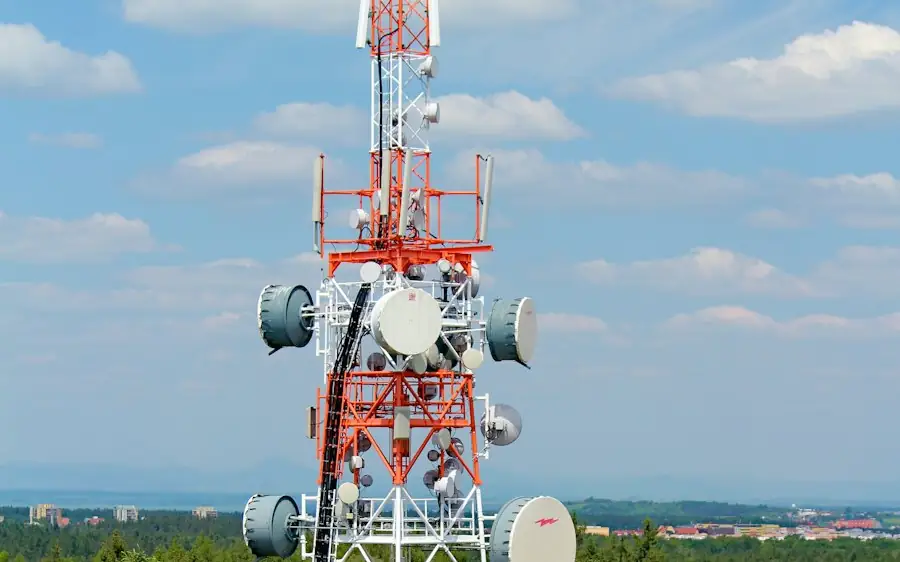
What backhaul has to deliver now
Backhaul carries traffic from radio sites, branches or remote facilities back to the core network. With commercial 5G launched in Egypt in 2025 and 4G traffic still growing, the requirements on that link have changed fast.
A modern backhaul design is judged on five things:
- Capacity per site today and in five years, including headroom for new carriers and bands.
- Latency and jitter, which matter for voice, real-time video and future 5G services.
- Availability, usually expressed as a target such as 99.99% or better per hop.
- Synchronisation, because LTE-TDD and 5G radios need accurate phase timing, not just frequency.
- Total cost of ownership over 10 years, not just the capex on day one.
No single medium wins on all five at every site. That is why the decision has to be made per cluster, with a clear rulebook.
Fibre backhaul: maximum capacity, slower to build
Fibre is the long-term answer wherever it can be reached. A single pair of G.652.D single-mode fibres can carry 10G, 25G or 100G today and be upgraded later by changing optics rather than the cable.
Strengths:
- Practically unlimited capacity and very low latency.
- Immune to rain fade and radio interference.
- No spectrum licence fees for the link itself.
Trade-offs:
- Civil works, permits and right-of-way take time, especially in dense urban areas and new cities.
- Cable cuts from third-party excavation are a real operational risk, so ring or dual-homed designs are needed for critical sites.
- Cost per site rises sharply for remote or isolated locations.
Where a fibre route already passes nearby, or an FTTx build is planned, extending it to the site is usually the best investment. Our fibre backbone and FTTx package covers that civil and splicing work.
Microwave backhaul: fast, flexible and still essential
Point-to-point microwave remains the fastest way to connect a new site. A link can be planned, licensed and commissioned in weeks rather than months, and it moves with the network if a site is relocated.
Typical options:
- Traditional bands (6–42 GHz) for hops of several kilometres, with capacities from a few hundred Mbps to several Gbps using high-order modulation and XPIC.
- E-band (70/80 GHz) for short urban hops of up to a few kilometres with multi-gigabit capacity.
- Multi-band links that pair E-band with a lower band, so traffic falls back gracefully during heavy rain.
The constraints are physical: line of sight, tower space and loading, rain-fade margins and frequency coordination. In Egypt, microwave frequencies are licensed and coordinated through the regulator, NTRA, so link planning must allow for that approval step.
Adaptive modulation means a well-designed link degrades capacity rather than failing outright, which suits mixed traffic with clear QoS classes.
Tower loading is often the hidden constraint. Every additional dish adds wind load, so a chain of microwave hops on shared towers needs structural checks before new antennas go up. Larger dishes give longer reach but cost more in tower rent and loading.
IP RAN: the transport layer that ties it together
IP RAN is not a physical medium; it is the routed transport layer that runs over fibre and microwave. Cell-site routers aggregate traffic and use IP/MPLS or segment routing to deliver it to the core.
Why it matters:
- Service separation with L2/L3 VPNs for 2G/4G/5G, enterprise and management traffic.
- Fast protection with sub-50 ms rerouting across rings and meshes.
- Timing distribution using IEEE 1588v2 (PTP) and SyncE, which 5G TDD radios depend on.
- Automation through a single controller, so new sites are provisioned from templates rather than manual CLI.
For operators, IP RAN is now the default architecture for access and aggregation. For enterprises with many distributed sites, the same principles apply on a smaller scale.
A practical decision framework
Rather than debating technologies in the abstract, we recommend classifying sites and applying rules:
- Hub and aggregation sites: fibre, ideally on diverse routes, with IP RAN routers at the edge.
- Dense urban sites near fibre: fibre spur first; E-band microwave as an interim or protection path.
- Suburban and highway sites: high-capacity microwave chains, planned so they can be shortened as fibre arrives.
- Remote, desert or temporary sites: microwave, often with long hops in lower bands; satellite only where nothing else is feasible.
Then check each plan against capacity forecasts, tower loading, power availability and the synchronisation design. Models that look cheap on capex can be expensive in opex if they need frequent site visits or spectrum renewals.
Operators, utilities and oil and gas companies with pipelines or remote facilities all face the same trade-off, just at different scales.
Plan for migration from the start. A microwave chain built today should be designed so that individual hops can be replaced by fibre later without re-engineering the whole IP RAN. Keeping consistent router platforms, addressing and timing design across both media makes that swap a routine change rather than a project.
Finally, keep capacity forecasts honest. Model busy-hour traffic per site with realistic growth for new 5G carriers and fixed wireless access, then add margin for protection switching. A link that runs at 80% on a normal day has no room left when its ring partner fails.
How Novatelx delivers it
Our transmission, optical, microwave and IP backhaul package follows our ten gated stages from survey to acceptance:
- Survey: line-of-sight checks, tower space and loading, fibre route walk-outs and power audits.
- Design: link budgets, rain-fade and availability calculations, ring topology, IP addressing and the PTP timing plan.
- Supply: radios, antennas, routers and optical modules from our technology partners, including ZTE.
- Install and commission: alignment, configuration and integration with the existing network.
- Test and accept: RFC 2544 or Y.1564 throughput tests, BER and protection switchover tests, documented against agreed acceptance criteria.
- Operate: 24/7 monitoring from our NOC, with preventive maintenance and fault response.
Frequently asked questions
Is fibre always better than microwave for backhaul?
Fibre offers more capacity and is immune to weather, but it is slower and costlier to build, especially in dense cities and remote areas. Microwave can be deployed in weeks and delivers multi-gigabit capacity over shorter hops. Most networks use fibre for hubs and aggregation and microwave for access sites, migrating to fibre as routes become available.
What is E-band microwave used for?
E-band uses the 70/80 GHz frequencies to deliver very high capacity, often 10 Gbps or more, over short hops of up to a few kilometres. It suits dense urban areas and 5G small-cell backhaul. Because heavy rain reduces its range, it is often paired with a lower-frequency link in a multi-band configuration for resilience.
What does IP RAN mean?
IP RAN is an IP/MPLS-based transport network for radio access sites. Cell-site routers aggregate traffic and route it to the core over fibre or microwave, with VPN separation, fast rerouting and timing distribution. It replaced older TDM and SDH backhaul and is the standard architecture for 4G and 5G transport.
Why does 5G need precise timing over backhaul?
5G TDD radios transmit and receive on the same frequency in alternating time slots, so neighbouring sites must be phase-aligned to avoid interference. Backhaul networks therefore carry timing using IEEE 1588v2 Precision Time Protocol and Synchronous Ethernet, often backed by GNSS receivers at key sites.
Do microwave links need a licence in Egypt?
Yes. Radio frequencies in Egypt are managed by the National Telecom Regulatory Authority (NTRA), and fixed microwave links normally require frequency assignment and coordination. Licensed operators handle this through their spectrum arrangements; enterprises should plan for the approval step and work with a partner familiar with the process.
Discuss your project with our engineers
Send the sites, the timeline and how success will be measured, and we will come back with a clear plan.
Talk to an engineer SD-WAN for Multi-Branch Enterprises in Egypt
 Telecom Tower & RF Site Rollout: Acquisition to On-Air
 Telecom & ICT Projects: Survey to Acceptance in Egypt